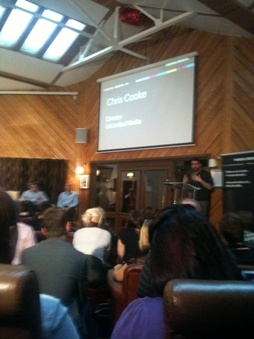
Last night saw the second of our Visionary Sessions programmes, held at Parr Street Studios, Liverpool.
The studios lent a really relaxed vibe to the evening.
It was inspiring listening to our speakers whilst in such a creative place (the room has been used by The Smiths, Coldplay, Echo and the Bunnymen -to name a few!)despite being a little on the warm side... should have turned off that (pretend) fire...
The evening kicked off with some networking drinks, before Kevin McManus, Head of Music here at Vision+Media, opened with a few words, welcoming our guests and introducing the evening. Kevin also mentioned our newly launched Skills programme - we are always looking for digital and creative companies to take on a training placement - to find out more please email
[email protected]
A Great Time for Content Producers - Nicholas Lovell
Nicholas Lovell opened with a rousing and refreshing look at the current landscape of the creative industries. Examining what would prove to be one of the key themes of the event, he delved in to the world of self-publishing. Self-publishing is a route that more and more creative content producers are taking, whether traditional print journalists, musicians, videogame developers, authors, photographers, TV producers or filmmakers. The old 'routes to market', that is, signing up with a publisher who will then distribute for a cut of the profit, are drying up. The bad news is that that market has gone, the good news is that it's a great time to be a content producer. No one can stop you if you want to make it happen.
Nicholas Lovell from Vision+Media on Vimeo.
Focus On The Media Value of Your Whole Package - Sean Marley
Next up was Sean Marley, Lime Pictures. Sean talked about Lime Pictures' dabblings with the new digital landscape, some of the pitfalls to avoid, and what they've learnt from the whole process. Pre-Google, Sean stated, Lime had three major outlets for their productions - now, there are countless platforms, but many with no/low budgets. Whereas previously they had just been program makers, now they are much more advertiser focused, targeting ad agencies for partnership deals. They have also partnered with public sector, for example creating an episode of Hollyoaks for the Government to warn the public of the dangers of binge drinking. Sean warned against trying to squeeze money out of distribution platforms such as Myspace and YouTube. Remember that these are distribution channels and not money making models. For Lime, the trick is to pull together a package for the whole media value of a product, that could contain the broadcast, an online game, networks - in order to sell the whole package. Partnerships are crucial to get this kind of package together. Lime have utilised the skills of companies such as Splinter and Milky Tea to help them achieve this.
Sean Marley from Vision+Media on Vimeo.
Top Ten Tips for IP Companies - Chris Cooke
Chris Cooke, from UnLimited Media, offered his top ten tips for IP companies:
1. Give Up Control. In this day and age the old idea of being able to protect your copyright is redundant. You can't stop people from taking your content for free - so beat them to it. Give it away, but make sure that you tie this in to your own marketing strategies, and take the power back. Accept that you have to give up control.
2. There are no more 'Golden Goose' revenue streams. Find a series of smaller incomes.
3. Find your core audience - and own them. Gone are the days of wanting to target everybody and anybody. Nowadays there is key value to be found in identifying your core market group and tailoring to them. These people will buy anything that you produce.
4. Add value to keep your audiences. Coldplay, for example, added a feature on their site enabling Coldplay fans to ask the band anything that they wanted to know, and get a personal response.
5. Monetize this added value! Can your band draw, as well as write music? Why not sell these drawings, or give them away with digital downloads? Mr Scruffs still DJs, but manages to make a living selling tea, after tea was always provided at his shows. There are ways of monetizing added value.
6. Audit your catalogue for inspiration - particularly larger organisations that may have forgotten what they own. Trawl back through for ideas.
7. Build better relations between corporate and creative sides of business. Cooke suggests that bitterness between bands and record labels would be lessened if the bands knew exactly what they were signing up for. If creative and business side are both aware of what is required from them, and the business model they are using, then this should lead to more collaborative working, and less misunderstanding, and more realistic targets.
8. Let different parts of your business start 'speaking' - for example property and performance within the music industry.
9. Forget the extremes - there are no more millionaire livings to be made from the creative industries - that was symptomatic of a different era. Now there might be a healthy living to be made, but forget the extremes and the excess.
10. Creativity is a Solution. The world always wants creativity and new innovation and new ideas. Constant innovation will drive you forward as a company.
Chris Cooke from Vision+Media on Vimeo.
Finding New Ways of Working - Dan Calladine
Dan Calladine gave an insightful and entertaining look at how you can find new ways of working with online media. Using examples from the music industry, Dan outlined how deceptively simple techniques and thinking outside the box can reap rewards. Steve Lawson is a guitarist who has played several international tours. After building up an online following, Steve decided to try something new, and invited his online fans to email him if they had a house large enough for him to gig in. With a phenomenal response from his audience, Steve managed to do a tour playing at his fans' houses. He had a great time, managed to sell t-shirts along the way, and didn't make a loss. He also met some great people. Perhaps he isn't going to become massively rich, but that whole idea has long since left the music industry. He also suggests having a fan club, like Prince or U2, where subscribers receive extra benefits/ more access to the website, etc. Overall the whole idea of 'success' and what warrants 'success' has changed within the music industry. Now you are doing well if you manage to make a living out of music, using many different revenue streams to build up a secure income.
Dan Calladine from Vision+Media on Vimeo.
Find the boring things that need to happen - and build a business around it - Chris Meehan
Sentric co-founder Chris Meehan reflects on his own experiences of graduating from a music industry degree, expecting a glittering career within the industry, and then realising the whole industry was completely screwed! For Chris, the answer came in an unlikely place. With the CD gone, and the industry attention moving to smaller revenue streams generated through performance royalties, Chris decided that this rather long and sometimes complex process could be made easier for small, unsigned acts who were all due money. For an admin fee, Sentric music collect and distribute performance royalties on behalf of bands. They also work actively to secure synchronisation in film and television. Chris insists that business models should be reduced to their simplest - you have the product you want to sell, you need to get that cheaper for what you sell it for, and the 'model' is how you do that. Often concentrating on the more boring, systematic, functional aspects of a supply chain are going to be where the lucrative business models are. People will always need them.
Chris Meehan from Vision+Media on Vimeo.
Q&A Session
Next the audience were invited to join in with a Q&A session, led by Nicholas Lovell.
Thank you to everyone who attended the event, I hope that you found it useful, inspiring, or at the very least entertaining.